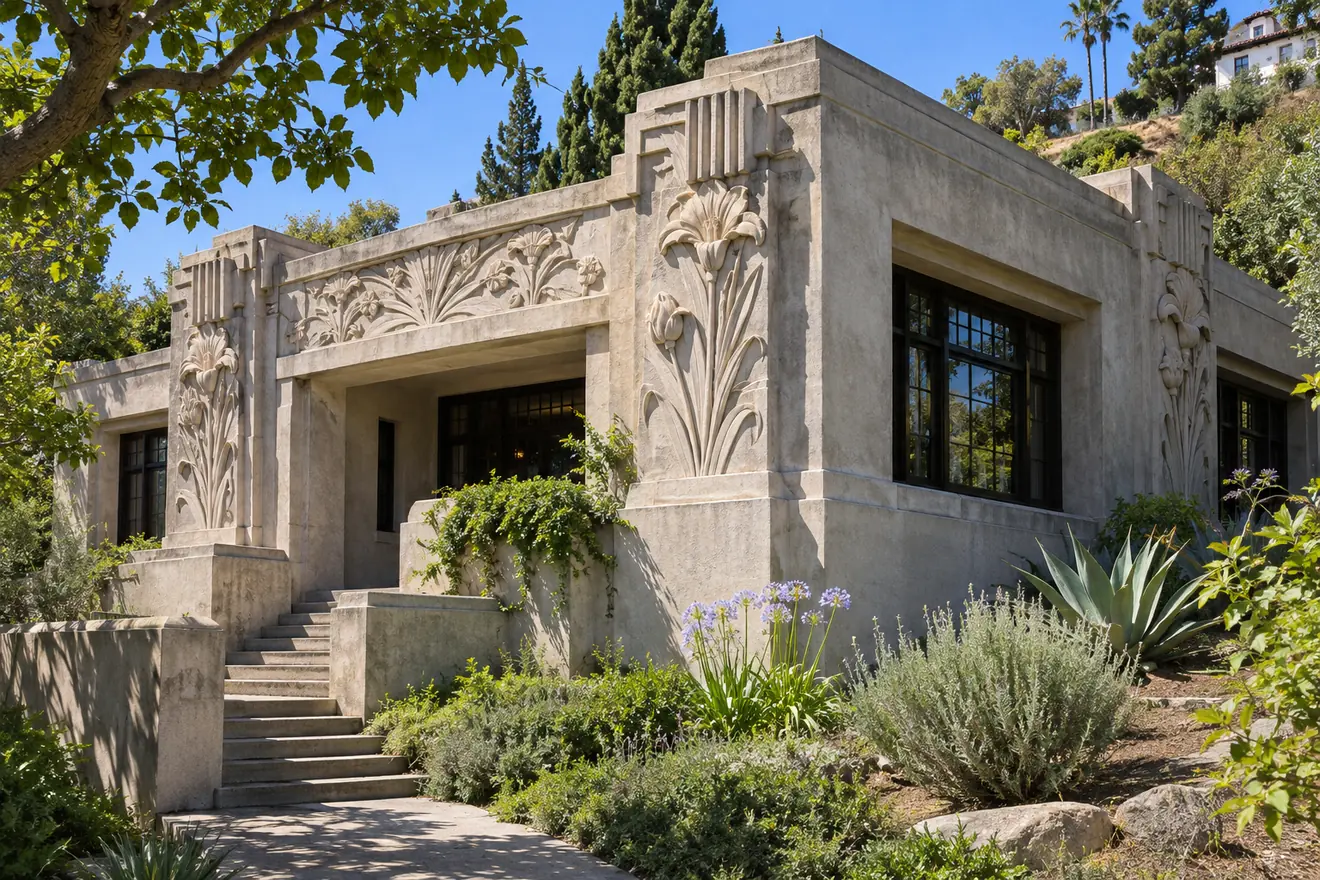
Beyond the movie palaces, Hollywood's built environment spans more than a century of American styles. The key landmarks are Frank Lloyd Wright's Hollyhock House (1919–1921), a UNESCO World Heritage Site in Barnsdall Art Park; the Capitol Records Building (1956), widely described as the world's first circular office tower; Crossroads of the World (1936), often called America's first outdoor shopping center; the Max Factor building (1935), now the Hollywood Museum; and the Hollywood Roosevelt Hotel (1927), site of the first Academy Awards. Most can be seen from the street without charge; Hollyhock House opens for paid tours Thursday through Saturday.
Landmarks at a glance
| Building | Year | Style | Can you go in? |
|---|---|---|---|
| Hollyhock House | 1919 to 1921 | Wright's California Romanza, Maya Revival influences | Yes, on ticketed tours |
| Hollywood Roosevelt Hotel | 1927 | Spanish Colonial Revival | Public areas of a working hotel |
| Max Factor building | 1935 (studio opening) | Hollywood Regency | Yes, as the Hollywood Museum, paid entry |
| Crossroads of the World | 1936 | Streamline Moderne and storybook styles | Courtyard visible from Sunset Blvd |
| Capitol Records Building | 1956 | Mid-century modern | No public access; view from the street |
Hollywood architecture: the main styles
Hollywood's landmark buildings reflect the rapid growth of Southern California from the 1910s through the 1950s. Spanish Colonial Revival, with its arched corridors, red-tile roofs and wrought-iron detail, defined the 1920s—the Roosevelt Hotel is the clearest example on the main boulevard. Art Deco arrived with the late 1920s and 1930s, bringing geometric ornament to theaters and civic buildings including Griffith Observatory. Streamline Moderne—the aesthetic of ocean liners and aeroplanes translated into concrete—shapes Crossroads of the World. Frank Lloyd Wright introduced a wholly different vocabulary: Hollyhock House merges what he called "California Romanza" with Mayan Revival influences. The 1950s brought Mid-Century Modern to the skyline in the form of the Capitol Records tower. The history of Hollywood tracks these shifts closely, since each style arrived with a new wave of investment and ambition.
Hollyhock House
Frank Lloyd Wright designed this house for Aline Barnsdall, an oil heiress and theater patron, and it was built between 1919 and 1921 on Olive Hill, a rise at Hollywood Boulevard and Vermont Avenue in East Hollywood. Wright decorated it with a stylized hollyhock, Barnsdall's favorite flower, which appears throughout in the cast concrete, the furniture and the art glass. Rudolph Schindler, who later became a major modernist in his own right, served as associated architect and took over as architect-in-charge in early 1921; Richard Neutra also worked on the project. The house is owned by the City of Los Angeles, and in 2019 it was inscribed on the UNESCO World Heritage List as part of "The 20th-Century Architecture of Frank Lloyd Wright," the first World Heritage listing in Los Angeles.
The surrounding Barnsdall Art Park is free to enter and has lawns with wide views across Hollywood toward the hills. Tours of the house run Thursday through Saturday, 11am to 4pm; advance tickets are recommended as popular dates sell out. Schedules and prices change seasonally, so confirm dates and book through the official Hollyhock House website before visiting. The Vermont/Sunset Metro station (B Line) is a short walk away.
Capitol Records Building
Completed in April 1956 at 1750 Vine Street, the 13-story tower was designed by Louis Naidorf of Welton Becket and Associates. With its round floors, curved sunshades and tall spire, it is widely described as the world's first circular office building and is often compared to a stack of records on a turntable—though the resemblance was coincidental, as Welton Becket had kept the client's identity secret during the design process. A light at the top of the spire blinks the word "Hollywood" in Morse code; when the building opened, it was switched on by Leila Morse, granddaughter of Samuel Morse. Inside are recording studios and eight echo chambers engineered by guitarist Les Paul, located more than 20 feet underground; the chambers produce reverb lasting up to five seconds. The building became a Los Angeles Historic-Cultural Monument in 2006 and was listed on the National Register of Historic Places in 2024.
There is no public access, but the corner of Vine and Yucca gives a good view, and the jazz mural by Richard Wyatt Jr. covers a wall beside it. The guide to Hollywood murals describes it.
Crossroads of the World
At 6671 Sunset Boulevard, Crossroads of the World opened on October 29, 1936, and is often called America's first outdoor shopping center. Architect Robert V. Derrah, known for the Streamline Moderne Coca-Cola Building in downtown Los Angeles, designed a central building shaped like an ocean liner, with portholes, railings and a tower topped by a globe. Around it, smaller buildings in styles evoking different countries gave visitors the sense of a trip around the world. In the 1950s, Alfred Hitchcock was among the directors who rented workspaces there. The globe tower became iconic enough that Disney reproduced it at Disney's Hollywood Studios in Florida. The complex was declared Los Angeles Historic-Cultural Monument No. 134 in 1974 and listed on the National Register in 1980. Today it houses offices, and the ship and globe are easy to see from the sidewalk on Sunset Boulevard.
Max Factor building
Max Factor, the makeup artist whose products shaped the look of early film stars, bought this building at 1660 North Highland Avenue in 1928. Its design is credited to architect S. Charles Lee, and after a remodel in the early 1930s the studio opened in 1935. It is Los Angeles Historic-Cultural Monument No. 593. The building now holds the Hollywood Museum, devoted to film and television memorabilia. Check the Hollywood Museum's official website for current hours and admission prices before visiting. It is one block south of the Walk of Fame and fits easily into the self-guided Hollywood Boulevard walk.
Hollywood Roosevelt Hotel
The 12-story Roosevelt opened in May 1927, named for President Theodore Roosevelt, and hosted the first Academy Awards ceremony in 1929. It is a Los Angeles Historic-Cultural Monument and sits across the boulevard from the Chinese Theatre. Public areas such as the lobby are part of a working hotel, so treat them as you would any private business.
Other buildings worth a look
- The movie palaces. The Egyptian, El Capitan, Chinese and Pantages theaters are architecture as much as entertainment. See the guide to Hollywood's historic movie palaces.
- Griffith Observatory. The 1935 Art Deco observatory on Mount Hollywood is a landmark you can enter for free. The Griffith Observatory visitor guide covers hours, parking and how to arrive without a car.
- The Hollywood Sign. Not a building, but Hollywood's most recognized landmark sits on Mount Lee above the hills. The guide to Hollywood Sign viewpoints covers the best spots and the access rules.
- The Hollywood Bowl shell. The 2004 shell continues a series of shells on the site going back to the 1920s.
Tips for architecture walks
- Check which way a facade faces before you go; morning light suits east-facing walls and late afternoon suits west-facing ones.
- Carry a wide-angle lens or phone setting; Crossroads and the Capitol tower are hard to fit in from across narrow streets.
- Respect working buildings. Offices, studios and hotels are private, even when they are landmarks.
- Check tour schedules weeks ahead for Hollyhock House, as popular dates sell out.
- Look for plaques. Many designated monuments have markers with dates and architects.
Frequently Asked Questions
Can you go inside the Capitol Records Building?
No. It is a working office and studio building without public access. You can view it from Vine Street and see the jazz mural on the adjacent wall.
Where is Frank Lloyd Wright's Hollyhock House?
It is in Barnsdall Art Park at 4800 Hollywood Boulevard in East Hollywood, near the Vermont/Sunset Metro station (B Line). Tours run Thursday through Saturday, 11am to 4pm; book in advance through the official Hollyhock House website.
What does the light on the Capitol Records Building spell?
The light on top of the spire blinks the word "Hollywood" in Morse code. When the building opened in 1956, it was switched on by Leila Morse, granddaughter of Samuel Morse, the inventor of Morse code.
Why is Hollyhock House a World Heritage Site?
In 2019 UNESCO inscribed it with seven other Wright buildings as "The 20th-Century Architecture of Frank Lloyd Wright." It was the first World Heritage listing in Los Angeles.
What is Crossroads of the World?
It is a 1936 complex on Sunset Boulevard built around a ship-shaped Streamline Moderne building with a globe tower. Often called America's first outdoor shopping center, it is now used for offices and is a city landmark.
What architectural styles can you see in Hollywood?
The main styles are Spanish Colonial Revival (1920s, as in the Hollywood Roosevelt Hotel), Art Deco (late 1920s to 1930s, Griffith Observatory), Streamline Moderne (Crossroads of the World), Mayan Revival and California Romanza (Hollyhock House), and Mid-Century Modern (Capitol Records Building). Each style reflects a distinct wave in Hollywood's development.