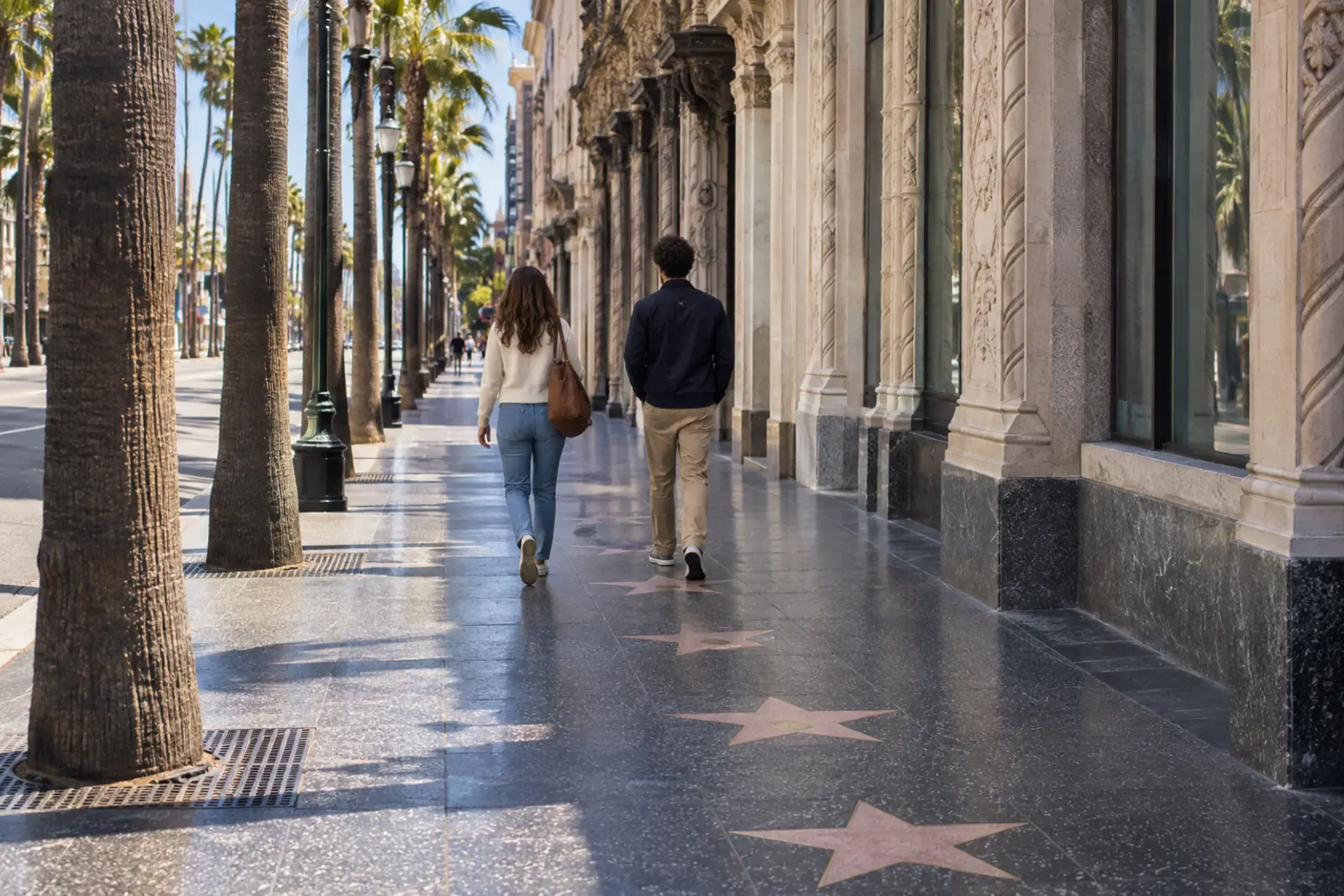
You do not need a paid tour to see the heart of Hollywood. This self-guided walk of about 1.5 miles along Hollywood Boulevard, from the Hollywood Roosevelt Hotel east to the Capitol Records Building on Vine Street, is free and passes the Chinese Theatre forecourt, the Dolby Theatre, the El Capitan and Egyptian theaters, the old Max Factor building, the best-known mural in the neighborhood and the Pantages. The sidewalk is the Hollywood Walk of Fame, which has more than 2,800 stars embedded across 15 blocks of Hollywood Boulevard and three blocks of Vine Street. Allow two to three hours with stops. Start at the Hollywood/Highland Metro station and finish near Hollywood/Vine, so you can ride back without retracing your steps.
The route at a glance
| Stop | Where | Distance from start (approx.) | Time to spend |
|---|---|---|---|
| 1. Hollywood Roosevelt Hotel | 7000 Hollywood Blvd | 0.1 miles | 5 minutes outside |
| 2. TCL Chinese Theatre forecourt | 6925 Hollywood Blvd | 0.15 miles | 20 to 30 minutes |
| 3. Dolby Theatre and Ovation Hollywood | 6801 Hollywood Blvd | 0.2 miles | 15 minutes, plus the Sign view |
| 4. El Capitan Theatre | 6838 Hollywood Blvd | 0.25 miles | 5 minutes |
| 5. Max Factor building | 1660 N Highland Ave | 0.35 miles | 5 minutes, longer if you go in |
| 6. Egyptian Theatre | 6712 Hollywood Blvd | 0.45 miles | 10 minutes |
| 7. You Are the Star mural | 1648 Wilcox Ave | 0.8 miles | 5 minutes |
| 8. Hollywood and Vine | Hollywood Blvd at Vine St | 1.1 miles | 5 minutes |
| 9. Pantages Theatre | 6233 Hollywood Blvd | 1.2 miles | 5 minutes |
| 10. Capitol Records Building | 1750 Vine St | 1.5 miles | 10 minutes |
Distances are rough and assume a direct line with a short detour south on Highland and Wilcox.
Self-guided Hollywood Boulevard walk: stop by stop
1. Hollywood Roosevelt Hotel
Leave the station, cross Hollywood Boulevard and walk a block west. The Spanish Colonial Revival hotel opened May 15, 1927, backed by Louis B. Mayer, Mary Pickford, Douglas Fairbanks and Sid Grauman. Its Blossom Ballroom hosted the first Academy Awards on May 16, 1929: 270 guests watched Fairbanks present twelve awards in fifteen minutes. The hotel's place in the early history of Hollywood is hard to overstate. You can admire the exterior and lobby entrance from the sidewalk.
2. TCL Chinese Theatre
Cross back to the north side. The theatre opened May 18, 1927, with Cecil B. DeMille's The King of Kings. The forecourt holds nearly 200 sets of celebrity handprints, footprints and autographs in concrete, beginning with a ceremony on April 30, 1927, when Mary Pickford and Douglas Fairbanks left the first impressions. Later celebrities got creative: Harold Lloyd pressed in his eyeglasses, and Betty Grable a leg print. The forecourt is free and is busiest from late morning on. This block is the busiest part of the Hollywood Walk of Fame.
3. Dolby Theatre and Ovation Hollywood
Next door, the Dolby Theatre has hosted the Academy Awards since 2002. Climb to the upper levels of Ovation Hollywood for a framed view of the Hollywood Sign up in the hills — this is one of the viewing areas recommended by the Sign's caretakers. For the full range of viewpoints across the city, see the guide to where to see the Hollywood Sign.
4. El Capitan Theatre
Look across the boulevard at the El Capitan, which opened May 3, 1926, as a live theatre — billed at the time as "Hollywood's First Home of Spoken Drama." It converted to films in 1937, and Orson Welles chose it for the world premiere of Citizen Kane on May 9, 1941. It is now owned by Disney and shows first-run films. The Egyptian, the Chinese and the El Capitan are covered in full in the guide to Hollywood's historic movie palaces.
5. Max Factor building
Walk a short way south on Highland Avenue. The Hollywood Regency-style building just south of the boulevard was Max Factor's makeup studio, designed by S. Charles Lee and opened in 1935, drawing the era's biggest stars. It is a Los Angeles Historic-Cultural Monument and now houses the Hollywood Museum, open Wednesday through Sunday, 10 am to 5 pm, with paid admission (around $15 for adults as of late 2024; verify current prices at the museum before visiting).
6. Egyptian Theatre
Return to the boulevard and head east. Behind a long courtyard, the Egyptian opened in 1922 and staged the first big Hollywood premiere — Douglas Fairbanks in Robin Hood. After earthquake damage in 1994 and years of closure, Netflix acquired and restored the building, and it reopened on November 9, 2023. Netflix programs it Monday through Thursday; the American Cinematheque takes Friday through Sunday.
On the way: Musso & Frank Grill
Continuing east from the Egyptian, you pass Musso & Frank Grill at 6667 Hollywood Blvd. Opened in 1919, it is the oldest restaurant in Hollywood, its booths and red-jacketed waiters largely unchanged since the era of Bogart and Chaplin. It opens for dinner; check current hours at their website before visiting.
7. You Are the Star
Continue east past Hudson Avenue and turn south on Wilcox. Thomas Suriya's 1983 mural shows film legends in theater seats looking back at you. More walls nearby are listed in the guide to Hollywood murals and street art.
8. Hollywood and Vine
Back on the boulevard, keep walking east to the intersection whose name became shorthand for show business in the radio and early television era. Stars line both streets here, and Vine Street has its own section of the Walk.
9. Pantages Theatre
Just east of Vine, the Pantages opened June 4, 1930 — the last movie palace built in Hollywood. Designed by B. Marcus Priteca in lavish Art Deco, it hosted the Academy Awards from 1949 to 1959, including the first televised Oscars ceremony in 1953. It now stages large Broadway-style shows.
10. Capitol Records Building
Finish by walking north on Vine to the 13-story circular tower, completed in April 1956. Architect Louis Naidorf designed it to resemble a stack of records on a turntable spindle. Its rooftop light spells out "Hollywood" in Morse code; at the opening, Leila Morse — granddaughter of Samuel Morse — turned it on. On the building's south wall is Richard Wyatt Jr.'s hand-glazed ceramic tile mural Hollywood Jazz: 1945–1972, which measures 26 by 88 feet. The Hollywood architecture guide covers the building in more detail. The Hollywood/Vine station is a short walk back down Vine.
When to go
- Early morning is calm and cool, with easy photos at the Chinese Theatre, but some buildings are closed.
- Late morning to mid-afternoon is busiest and warmest, but the Sign is well lit.
- Evening brings marquee lights; stick to busy, well-lit blocks.
- Check closures. Premieres, star ceremonies and the Oscars close sidewalks or whole blocks, sometimes for days.
Street smarts on the boulevard
- Costumed characters pose for photos and ask for tips. Agree on an amount before the picture, or politely decline.
- Do not accept items such as CDs or wristbands from strangers; the "gift" is often followed by a demand for money.
- Tour sellers on the sidewalk pitch bus tours of celebrity homes. If you are curious, research the company first instead of buying on the spot.
- Keep bags zipped and phones in front pockets in dense crowds.
- Use crosswalks. The boulevard is busy, and drivers are watching for parking, not pedestrians.
Extending the walk
If you have energy left, ride the Metro two stops east and take the DASH bus up to Griffith Observatory for sunset, or head south to Hollywood Forever Cemetery. The guide to getting around Hollywood without a car explains fares and connections.
Frequently Asked Questions
How long does a self-guided walk of Hollywood Boulevard take?
The 1.5-mile route takes about 40 minutes of walking, but plan two to three hours with stops at the Chinese Theatre, the theaters and the murals.
Where should I start a walking tour of Hollywood?
Start at the Hollywood/Highland Metro station, which puts you beside the Chinese Theatre and the Dolby Theatre, and finish near Hollywood/Vine so you can ride back without retracing your steps.
Is Hollywood Boulevard safe to walk?
The main tourist blocks are busy during the day, and most visitors walk them without trouble. Watch your belongings in crowds, avoid accepting items from strangers and keep to busy, well-lit areas after dark.
Do I need to pay the costumed characters?
Only if you agree to a photo. Characters usually expect a tip for posing, so settle on an amount first or simply decline and keep walking.
Can I see the Hollywood Sign from Hollywood Boulevard?
Yes. The upper levels of Ovation Hollywood at Hollywood and Highland give a clear, if distant, view of the Sign in the hills.
How do I find a specific star on the Walk of Fame?
Stars are not arranged alphabetically or by category, so look up the address in advance at walkoffame.com, the official directory. The busiest and most photographed stretch runs between the TCL Chinese Theatre and Ovation Hollywood, where most A-list stars are concentrated.